
North Las Vegas Directory Landscape
North Las Vegas people directories work best when the source matches the person’s known role. City leadership and department rosters identify public officials. School and university directories locate institutional contacts. Clark County land systems list recorded parties and assessed owners, while state licensing databases identify professionals and business principals. Libraries and archives carry the search into earlier decades through city directories, newspapers, census sources, and yearbooks.
| Directory source | People represented | Record keeper | Access route |
|---|---|---|---|
| Leadership and department rosters | Officials, executives, appointees, selected staff | City of North Las Vegas | Free browse; department or Clerk fallback |
| Education directories | UNLV faculty and staff; CCSD schools and contacts | UNLV and CCSD | Free search or browse; school or department fallback |
| State employee directory | Nevada personnel in public roles | State of Nevada | Free search; agency main office fallback |
| Recorder and Assessor indexes | Instrument parties and assessed owners | Clark County | Free indexes; mail, counter, and staff help |
| Business and license lookups | Entities, agents, principals, and licensees | Nevada agencies and boards | Free verification; board or licensing office |
| City, reverse, and phone directories | Past residents, businesses, and address-linked occupants | Library and archival collections | Card database, catalog, reference desk, or repository |
Start with the narrowest official source. A role or agency points to a staff roster. A campus unit points to an education directory. An address points to the Assessor and then the Recorder. A historical name belongs in library and archival tools. Each system defines a different relationship, so an entry should not be stretched beyond its stated field.
North Las Vegas Government Directories
The City Leadership Team is a browsable roster, not an all-employee search. Its profiles identify a leader by name, title, photograph, and biography. Mayor, Council, board, and commission pages add elected and appointed names. Clark County department pages perform a similar role for county offices, but the research found no verified countywide employee name search.
A more detailed city directory exists within Fire Prevention. Its published staff roster supplies names, titles, office and cell numbers, and direct city email addresses. The department lists 702-633-2616 and Monday through Thursday hours of 7 a.m. to 5 p.m. Because personnel can change, confirm a roster entry with the department before relying on it.
A typical North Las Vegas government directory entry may contain:
- the person’s full or published name;
- an official title and assigned department;
- a work telephone number or department line;
- a city email address when the roster provides one;
- a biography, photograph, ward, board, or public role.
If a name is absent, call the department’s main number first. The City Clerk can identify the custodian for boards, council material, and municipal files. A focused request through the city records request route is the fallback for an existing public record, but confidentiality still applies.
North Las Vegas Education Directory Search
The UNLV Directory is the broadest verified education people directory in the Las Vegas Valley. It searches people and departments across the university. A normal public result can show a full name, title, unit, campus mail or office location, work phone, institutional email, and a linked department. Display is not universal, so a missing result may reflect a restricted entry or a person who is no longer current.
| UNLV field or control | Input type | Required | Use in a search |
|---|---|---|---|
| Search | Text | Yes | Enter a person or department keyword |
| People / Departments | Tab or filter | No | Limit the type of result |
| Name | Text concept | No | Try first, last, or a partial name |
| Department | Result or filter | No | Check the organizational affiliation |
| Search button | Button | Not applicable | Submit the chosen terms |
The Clark County School District directory is organized around schools, departments, and administrative contacts. Staff detail varies by school. When the directory does not identify an individual, use the school or department office rather than assuming the person has no CCSD connection. College of Southern Nevada also publishes campus, unit, and faculty pages, though no single resident directory was verified.
North Las Vegas Property Directories
The Clark County Assessor Real Property search functions as an owner directory. Search modes include parcel number, owner name, address, subdivision name, subdivision owners, parcel type or book and page, a Parcel Number Tree, and a map inquiry. A parcel page can show the vested owner name, mailing address, situs address, assessor’s parcel number, legal description, tax district, assessed values, improvements, and map or sketch links.
The Recorder Acclaim system is a different type of name directory. It connects grantors and grantees to deeds, liens, homesteads, releases, plats, and other recorded instruments. A grantor transfers an interest; a grantee receives one. Search former names, initials, and both transaction roles. The Recorder does not publish one universal online start year, so an older citation may require book and page searching or help from staff.
Read the role first. An assessed owner, a recorded-document party, and a directory occupant are three distinct labels. None alone proves who currently lives at an address.
When a web portal fails, the access path continues. Recorder copies can be ordered online, by mail, or at the counter. Assessor staff can help with current parcel records. OpenWeb GIS verifies the parcel and city boundary, while older or closed permit material can be sought from the correct city or county custodian. The detailed request rules belong with North Las Vegas public records access.
North Las Vegas License Directories
Nevada’s professional and business directories are split by keeper. The Secretary of State Entity Search accepts an entity name or Nevada business identifier. Results and filings may identify the legal name, status, entity type, jurisdiction, formation dates, registered agent, address, and principals when the filing requires them. A registered agent receives legal service for an entity; that label does not establish the person as an owner or resident.
Individual license status comes from the responsible board. Relevant sources include the State Bar of Nevada, Contractors Board, Real Estate Division, medical and nursing boards, Cosmetology Board, education licensing, and mortgage licensing records. Search by license number when one is known because names can collide. North Las Vegas business licensing adds local authorization, while Clark County fictitious-firm-name records connect a trade name with certificate parties.
These directories answer separate questions. The state entity record identifies a legal business. A county filing identifies a name used in trade. The city license addresses local permission, and a professional board verifies an individual credential. Chamber lists cover participating organizations only. If an online index lacks an older entry, contact the board, Business Licensing, or County Clerk for the record set that owns the missing fact.
North Las Vegas Library Directories
North Las Vegas Library District branches serve city residents, while the Las Vegas-Clark County Library District offers countywide genealogy tools. Its genealogy resources include federal census material, family and local histories, city-directory content, historic Las Vegas Review-Journal access, and broad newspaper archives. A library card or in-library session may be required for licensed databases.
| Library holding or tool | Useful name evidence | Published year coverage | Fallback |
|---|---|---|---|
| Las Vegas city directories | Name, address, occupation, spouse where printed | Exact volume run not published | Ask reference staff for a shelf inventory |
| Reverse or criss-cross volumes | Street address or phone number to occupant | Exact local years not published | Ask which branch or off-site store holds them |
| Historic newspapers | Obituaries, relatives, legal notices, community ties | Database-specific | Search card databases or consult a librarian |
| School yearbooks | Students, faculty, clubs, and photographs | Volume-specific | Check libraries, schools, and archives |
The years gap matters. Neither library’s official public pages state a complete volume-by-volume run for Polk, telephone, or reverse directories. Do not infer missing dates from a general collection label. Ask staff whether a named year is at a branch, in storage, or available through a licensed database.
The successful library capture comes from the official Las Vegas-Clark County Library District genealogy page.
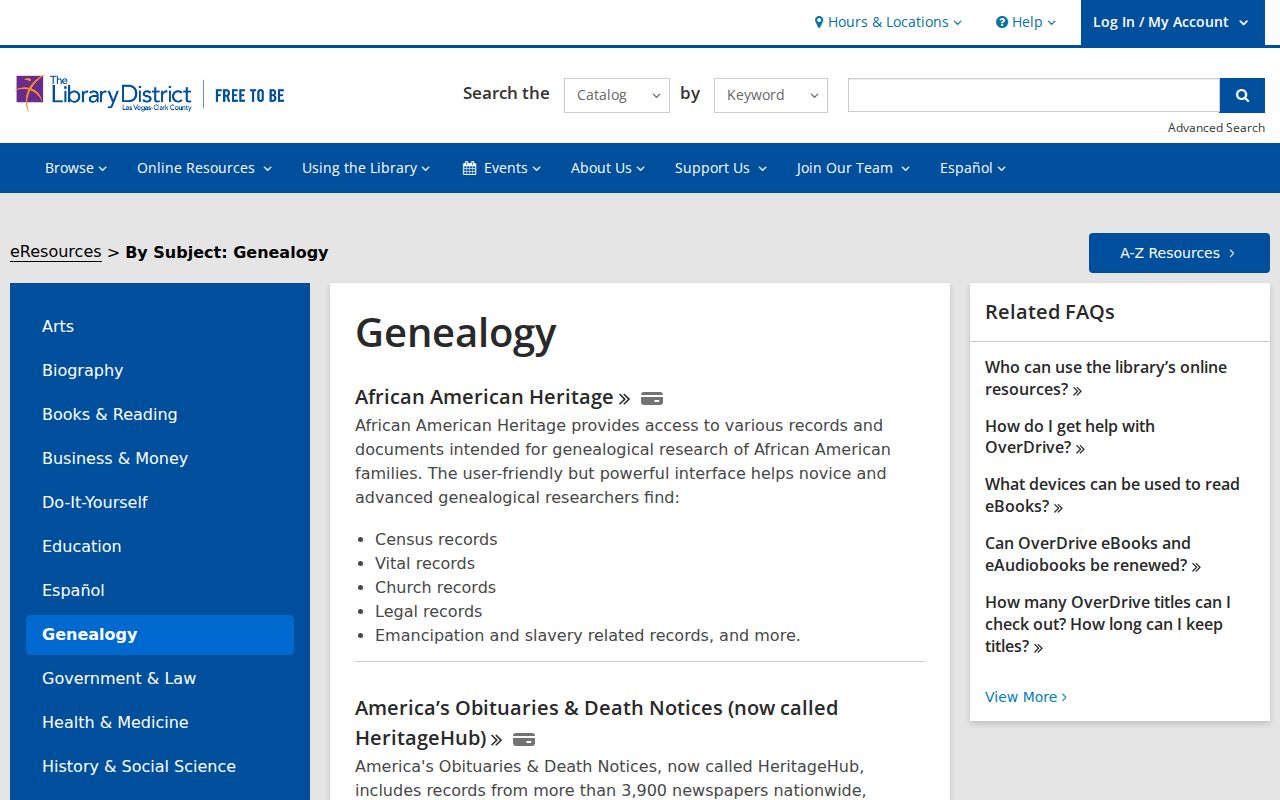
The resource screen confirms the library as a starting point, while a librarian remains the key fallback for exact city-directory years and access conditions.
North Las Vegas Directory Geography
Historical directory labels do not track today’s city boundary. North Las Vegas incorporated in 1946, and earlier residents may be indexed under Las Vegas, Clark County, Las Vegas Township, or a precinct name. Even later metropolitan volumes may place North Las Vegas listings inside a book titled for Las Vegas. Searching only the modern city name can miss the right household.
Geography also determines the repository. Clark County was formed from Lincoln County in 1909, so earlier land and court research may lead outside the present county series. North Las Vegas annexations can change which government holds permits without the site itself moving. An address should be checked against the Assessor and GIS before selecting a city or county file.
Clark County has one unusual federal archive route. The National Archives at Riverside, rather than the San Francisco branch used for the rest of Nevada, is responsible for Clark County federal genealogy and naturalization material. That boundary can help families locate a federal name index or case that does not appear in local directories.
Note: Search Las Vegas-labeled books, township terms, and Clark County headings before concluding that an older North Las Vegas resident is absent.
Historical North Las Vegas Directories
Printed people directories recorded different kinds of relationships over time. A standard alphabetical directory usually moved from surname to address and sometimes occupation or spouse. A reverse directory, also called a criss-cross directory, began with a street or telephone number and returned the listed occupant. Telephone books can preserve a household or business listing, but they do not cover every person.
- City directory
- An alphabetical list that may connect a person or business with an address, occupation, or spouse.
- Reverse directory
- An address-first or telephone-first volume used to identify the listed occupant at a point in time.
- Directory occupant
- The person printed for that address or number, not automatic proof of ownership or continuous residence.
- Finding aid
- An archive’s description of a collection, often naming people, organizations, dates, and boxes available for research.
The record timeline explains where to look. Clark County begins in 1909. Statewide Nevada birth and death filing begins July 1, 1911. North Las Vegas incorporates in 1946, and the public 1950 census now supplies a name-searchable population schedule under the 72-year release rule. Those dates help bracket a person before a catalog, newspaper, census, or archive search.
North Las Vegas Community Name Indexes
Yearbooks, newspapers, obituary files, cemetery records, and oral histories extend directory research beyond government indexes. CCSD and UNLV yearbooks can identify classmates, teachers, clubs, and photographs, though availability varies by volume and keeper. UNLV Special Collections and University Archives holds regional manuscripts, photographs, oral histories, newspapers, maps, and community collections. Search a finding aid before requesting boxes.
Historic newspapers connect names with relatives, schools, churches, businesses, legal notices, and former addresses. Obituaries can help reconnect family lines or identify heirs, but spelling should be checked against official indexes. Cemetery memorial databases are derivative. Confirm a result with a cemetery office register, marker, obituary, or certificate when lawful access is available.
Faith and community repositories may hold parish, congregation, funeral, neighborhood, union, club, or oral-history records. These are not automatically public. The organization sets its own access terms, and some sacramental records require proof of relationship or attention to date limits. The Nevada State Archives is another fallback for county, local-government, election, and historical indexes.
North Las Vegas Directory Fallbacks
Current residential white pages are incomplete. Mobile-only households, unlisted numbers, changed service, and shared plans leave gaps, and no official carrier-maintained white-pages directory specifically for North Las Vegas was verified. A missing phone listing is therefore weak evidence. For historical work, library telephone books are more useful because they preserve a dated snapshot, even though they also omit people.
Use a source-specific fallback when an online directory fails:
- For a public official or staff contact, call the department or agency main line and ask for the correct unit.
- For education contacts, use the school, college, or department office when a person search returns no entry.
- For owner or recorded-party names, contact the Assessor or Recorder and supply an APN, document number, book and page, or date range.
- For historical residents, ask library staff for city-directory and phone-book years, then check archives, newspapers, yearbooks, and census records.
- For a license or business role, contact the board, Secretary of State, County Clerk, or city licensing office that maintains that exact record.
Record the spelling, role, date, and keeper for every useful entry. Try former names, initials, two-surname forms, suffixes, and old address terms when an index is rigid. Directories are strongest when two independent sources agree and each is read within its real scope.
Use directories lawfully. Public work contacts and name indexes may support family, civic, property, or historical research. They must never be used to stalk, harass, or harm anyone.